
OKR vs KPI: A Clear Guide for Singapore Professionals


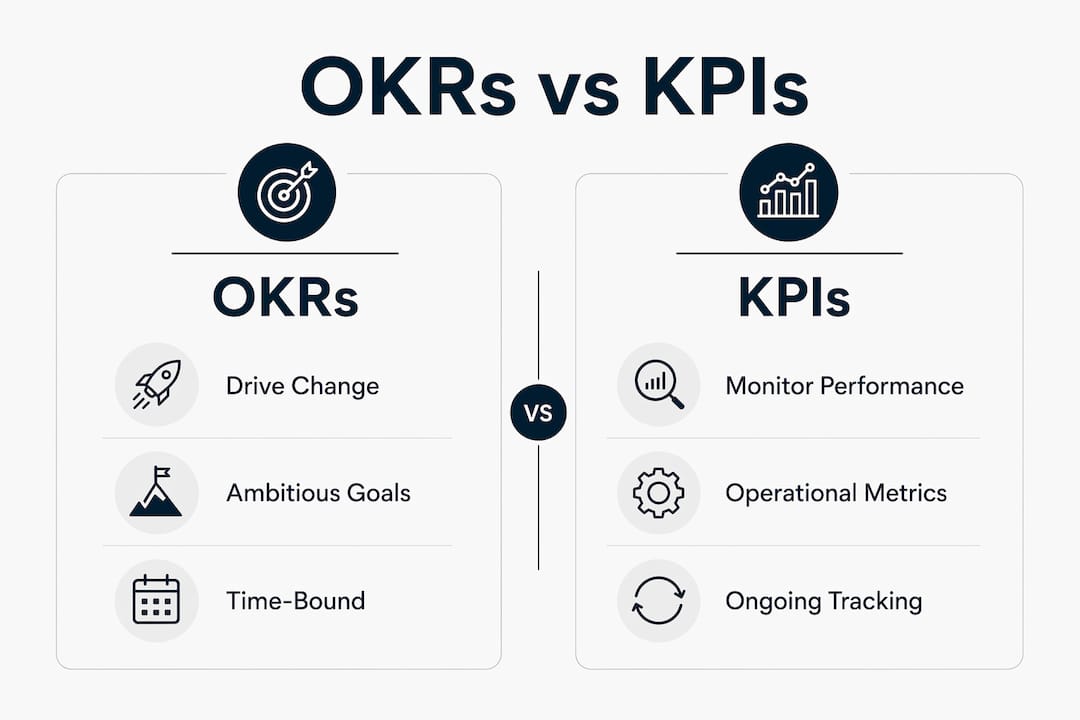
OKRs and KPIs are not interchangeable. They serve distinct, complementary roles, and confusing them is one of the most common performance management mistakes managers make. OKRs (Objectives and Key Results) drive strategic change by pairing an ambitious qualitative objective with three to five measurable key results. KPIs (Key Performance Indicators) monitor ongoing operational health through quantitative metrics tied to specific targets, owners, and review cadences.
At a glance:
OKR components: Objective (the aspirational “what”) + Key Results (the measurable “how”), scored on a 0–1 scale, typically set quarterly
KPI components: Metric + defined target + named owner + review cadence, as management experts confirm
OKRs push teams toward breakthrough change and new territory
KPIs tell you whether existing operations are healthy right now
A KPI showing underperformance is often the trigger for setting a new OKR
Think of KPIs as the dashboard gauges in a car and OKRs as the navigation system. You need both. KPIs serve as guardrails that alert management when a process is faltering, while OKRs act as the steering wheel to navigate change and seize opportunities.
How OKRs and KPIs compare side by side
OKRs and KPIs share common ground: both align teams around goals, both rely on measurable outcomes, and both feed into performance management. The differences, though, are significant.

Dimension | OKRs | KPIs |
Primary purpose | Drive change and improvement | Monitor ongoing performance |
Focus | Aspirational, stretch goals | Operational health and stability |
Timeframe | Quarterly or annual | Monthly, weekly, or daily |
Ambition level | Deliberately stretchy; 0.7 is often a strong score | Target-bound; hitting 100% is the goal |
Structure | Objective + 3–5 key results | Metric + target + owner + cadence |
Flexibility | Dynamic; adjusted based on results | Steady benchmarks, consistent over time |
Best used for | New initiatives, transformation, alignment | Tracking business health, identifying trends |

One nuance worth noting: KPIs and key results are not the same thing, but they can overlap. A KPI tracking customer satisfaction can become a key result inside an OKR aimed at improving the customer experience. Once an OKR is achieved and the new standard is locked in, that outcome often converts into a standing KPI to maintain going forward.
A metric only becomes a KPI after passing a promotion gate: it must link to a specific objective, carry a defined target, have a named owner, and sit on a regular review cadence. Without all four components, it remains a useful metric but not a KPI. That discipline prevents dashboard overload and keeps executive attention focused where it matters.
What OKRs and KPIs look like across business functions
Seeing both frameworks applied to real business functions makes the distinction concrete.
Sales
OKR: Objective: Break into the enterprise segment in Singapore. Key Results: Close multiple enterprise accounts by end of Q3; increase average deal size; reduce sales cycle duration.
KPI: Monthly recurring revenue (MRR) target of SGD 500,000; reviewed weekly by the sales director.
Marketing
OKR: Objective: Build brand authority in the Singapore market. Key Results: Grow organic traffic significantly; gain new email subscribers monthly; earn multiple media mentions within the quarter.
KPI: Cost per lead (CPL) maintained below SGD 35; reviewed monthly.
Customer Service
OKR: Objective: Deliver a best-in-class support experience. Key Results: Improve Net Promoter Score substantially; reduce average response time considerably; resolve most tickets on first contact.
KPI: First contact resolution (FCR) rate; reviewed daily by the support team lead.
Product Development
OKR: Objective: Launch a feature set that retains power users. Key Results: Ship multiple high-priority features by quarter end; achieve strong adoption among active users shortly after launch.
KPI: Monthly active users (MAU); reviewed weekly.
Operations
OKR: Objective: Reduce operational costs without sacrificing quality. Key Results: Cut vendor costs noticeably; reduce order processing time significantly.
KPI: On-time delivery rate; reviewed weekly by the operations manager.
The intent behind each framework shows clearly here. KPIs confirm that existing processes are running within acceptable parameters. OKRs define where the organization needs to go next.
Why measuring performance with both frameworks matters
Relying on KPIs alone tends to produce stagnation. Teams hit their targets, maintain the status quo, and have no structured mechanism to pursue the next level of growth. Relying on OKRs alone, particularly when applied to routine operational tasks, creates what practitioners call goal fatigue. Using OKRs to track business-as-usual work generates bureaucratic overhead and dilutes their impact on genuine breakthrough priorities.
Atlassian describes OKRs as “KPIs with soul.” KPIs indicate what is happening; OKRs provide the strategic direction and the organizational permission to drive change, including the freedom to take calculated risks without penalty for falling short.
The practical integration works in both directions. When a KPI signals underperformance, that is the cue to set an OKR addressing the root cause. When an OKR is achieved and the new standard is established, it converts into a KPI to maintain that level going forward.
Pro Tip: The single biggest failure in OKR execution is skipping weekly check-ins. Regular progress reviews maintain momentum and accountability across a full quarterly cycle. Schedule a 15-minute team check-in every Monday, keep it structured around three questions: What progress was made? What is blocking us? What needs to change this week?
Practical guidance for Singapore professionals applying OKRs and KPIs
Singapore’s business environment rewards precision and accountability, which makes both frameworks particularly well suited to local organizations. For managers navigating this context, a few practical considerations apply.
OKR Singapore, located at 33A Pagoda St, Singapore 059192, is a verified local consultancy offering tailored OKR advisory services to Singapore-based organizations. For teams new to the framework or looking to reset a struggling implementation, working with a local specialist who understands Singapore’s organizational culture and reporting norms can accelerate adoption considerably.
Common implementation challenges and how to address them:
Q: Should Singapore companies implement KPIs before OKRs? Getting KPIs in place first is generally the stronger approach. KPIs establish the operational baseline and surface the underperforming areas that OKRs should then target. You cannot set a meaningful OKR to improve customer retention if you have not been tracking retention as a KPI.
Q: How many OKRs should a team carry at once? Three to five objectives per quarter is the widely accepted ceiling. More than that and teams lose focus. Each objective should carry no more than five key results. For team leaders managing performance, this discipline is especially important: too many OKRs signal a lack of prioritization, not ambition.
Q: What is the right review cadence for KPIs in Singapore organizations? High-priority KPIs, particularly those tied to sales, customer service, or cash flow, warrant weekly or even daily review. Strategic KPIs can be reviewed monthly. The cadence should be defined when the KPI is set, not left to “whenever someone asks.”
Q: Can OKRs work for individual contributors, not just teams? Individual OKRs often produce task-oriented key results rather than genuine outcome measures. The framework works best at the team or departmental level, where collective effort can move a meaningful metric. Individual performance is generally better tracked through KPIs tied to role-specific targets.
The core concepts behind OKRs and KPIs
Andrew Grove introduced the OKR framework at Intel in the 1970s. John Doerr later brought it to Google in the late 1990s, and it has since been adopted by organizations across industries globally. The framework’s core logic is simple: the objective defines where you want to go, and the key results define how you will know you have arrived.
KPIs have been in use for nearly a century, embedded in management practice long before OKRs emerged. Every organization already tracks KPIs in some form, whether formally labeled or not. Revenue, customer satisfaction, and employee turnover are all KPIs when they carry a target, an owner, and a review cadence.
The distinction between a metric and a KPI is not semantic. It is a governance mechanism. Metrics monitor; KPIs manage. Treating every metric as a KPI collapses this hierarchy and forces every indicator to compete for the same limited executive attention.
How OKRs and KPIs fit into strategic planning
OKRs operate at the intersection of ambition and execution. They translate a company’s annual strategy into quarterly priorities that every team can act on. KPIs provide the continuous data layer that confirms whether the organization’s core operations remain healthy while those strategic bets are being pursued.
In practice, the two frameworks reinforce each other at every planning horizon. Annual strategy sets the direction. Quarterly OKRs break that direction into focused, achievable objectives. KPIs run continuously in the background, flagging when operational health requires attention. When a KPI turns red, it often becomes the input for the next OKR cycle.
For experienced agents and managers building performance frameworks within their teams, this layered approach provides both the accountability of measurable targets and the ambition of stretch goals working in parallel.
How Singapore companies are applying OKRs and KPIs
Singapore’s technology and financial services sectors have been early adopters of OKR-based goal setting, often layered on top of existing KPI frameworks. A property agency, for example, might track monthly transaction volume and conversion rate as standing KPIs, while setting a quarterly OKR to expand into a new residential district, with key results tied to new client acquisitions, listing volume, and agent onboarding targets.
A logistics firm might use KPIs to monitor on-time delivery rates daily, while running an OKR to redesign the last-mile delivery process entirely, with key results measuring pilot route efficiency and customer satisfaction scores. The KPI flags the problem; the OKR drives the solution.
What distinguishes high-performing Singapore organizations in this space is the discipline to keep OKRs genuinely ambitious and KPIs genuinely operational. When the two blur, teams end up with neither a reliable performance dashboard nor a credible strategic agenda.
Key Takeaways
OKRs drive strategic change while KPIs monitor operational health, and Singapore professionals who use both together gain a complete, actionable view of organizational performance.
Point | Details |
OKRs vs KPIs core difference | OKRs set ambitious direction; KPIs confirm ongoing operations are healthy. |
KPI promotion gate | A metric becomes a KPI only when it has a target, owner, and review cadence. |
Integration approach | Use KPI underperformance as the trigger for setting a new OKR each quarter. |
Weekly check-ins matter | Regular OKR progress reviews maintain momentum across the full quarterly cycle. |
Singapore application | Keep OKRs genuinely stretch-oriented and KPIs strictly operational to avoid goal fatigue. |
Myeracareer supports real estate professionals in Singapore with performance-driven career frameworks, mentorship, and leadership development. Whether you are building your first goal-setting system or refining how your team tracks results, the principles behind OKRs and KPIs apply directly to how top agents and team leaders structure their growth. Explore how Myeracareer’s new agent programs integrate performance tracking from day one.

Recommended
Comments