
RES Exam Singapore: Your Complete 2026 Licensing Guide


The Real Estate Salesperson (RES) exam is the mandatory licensing examination every aspiring property agent in Singapore must pass before practicing legally. Regulated by the Council for Estate Agencies (CEA), it serves as the profession’s quality gateway, confirming that candidates understand Singapore’s property laws, HDB regulations, and agency ethics at a minimum competency level.
Here is what you need to know at a glance:
The exam comprises two papers, each lasting 2.5 hours with 80 multiple-choice questions per paper.
You must achieve at least 60 marks out of 100 on each paper to pass.
Before you can even register, you must complete the RES course at a CEA-Approved Course Provider (ACP).
Passing both papers qualifies you to register as a licensed salesperson under a licensed estate agency.
The RES course completion certificate is valid for a limited time, so timing your exam attempt matters.
Table of Contents
How to apply for the RES exam in Singapore
Registration follows a two-stage, first-come-first-served process. Seats fill quickly, so preparation before the registration window opens is not optional.
Stage 1: Indication of Interest
Submit your interest via the GovEntry portal using your Singpass credentials.
This stage does not confirm your seat. It places you in the shortlisting queue.
Shortlisting is competitive. Timing your submission early in the window significantly improves your chances.
You must hold a valid RES course completion certificate at this stage.
Stage 2: Registration and Payment
Shortlisted candidates receive notification and proceed to NTUC LearningHub’s website to complete registration and pay fees.
Payment must be completed within the stipulated window or your slot is forfeited.
Prepare your educational qualification documents for submission during this stage.
Pro Tip: Set a calendar reminder for the Indication of Interest opening date. Candidates who log in within the first few hours consistently report better shortlisting outcomes, given the high demand and limited seats.
What are the eligibility requirements to sit for the exam?
The CEA sets clear prerequisites. Meeting every criterion before you register saves you from a rejected application.
Age: Minimum 21 years old at the time of registration.
Education: At least four GCE O-Level passes or equivalent WPLN Level 5 literacy and numeracy.
RES course: Mandatory completion of the RES course from a CEA-approved provider. Certificates from non-approved providers are not recognized.
Certificate validity: The completion certificate is valid for two years. If it lapses before you pass both papers, you must retake the full course.
Document submission: Educational qualification documents are required during Stage 2 registration.
Exemptions: Holders of certain real estate-related degrees may qualify for partial exemptions. Check directly with CEA for your specific qualification.
What does the RES exam cost, and how do you pay?
Fees are fixed and inclusive of GST. There is no sliding scale based on income, and no official financial assistance program is currently listed for the examination itself.
Full sitting (both papers): $512.30 inclusive of GST.
Modular sitting (one paper only): $283.40 inclusive of GST.
Payment is completed during Stage 2 registration via NTUC LearningHub’s website.
Deferment fees apply if you need to postpone after registration. These fees are non-refundable.
Absenteeism without an approved deferment is recorded as a fail, and fees are forfeited entirely.
Plan your finances and your schedule together. Paying $512.30 and then missing the exam because of a scheduling conflict is an avoidable loss.
Understanding the exam format, syllabus, and question style
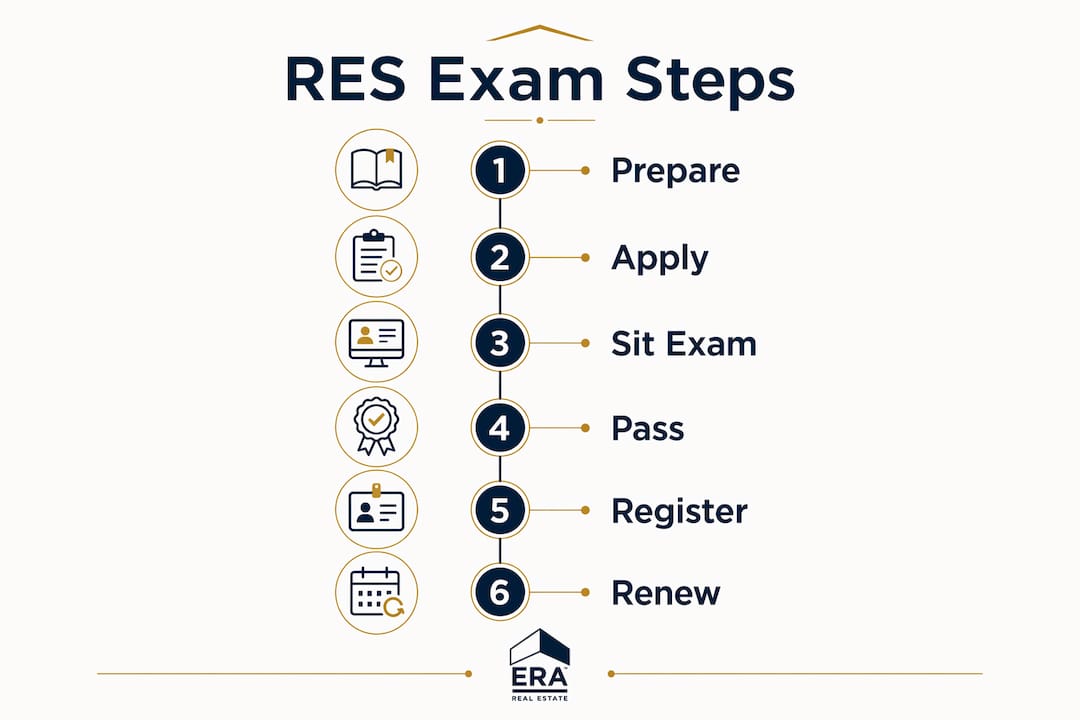
The RES examination consists of two papers, each 2.5 hours long, with 80 multiple-choice questions per paper. Passing requires meeting the minimum mark set for each paper independently. Passing one and failing the other means you sit only the failed paper again on a modular basis.

Paper | Sections | Questions | Marks | Duration |
Paper 1 | Real estate laws, HDB regulations, property transactions | 80 MCQs | 100 | 2.5 hours |
Paper 2 | Agency practice, ethics, client management, market knowledge | 80 MCQs | 100 | 2.5 hours |
Key syllabus topics include:
Property law and conveyancing procedures
HDB eligibility rules and resale regulations
Private residential and commercial property transactions
Real estate agency practice and code of ethics
Anti-money laundering obligations
CPF usage in property purchases
Stamp duties and taxation basics
Questions are scenario-based, not purely definitional. A typical question presents a client situation and asks which course of action complies with CEA guidelines or property law. Rote memorization of definitions will only take you so far.
Pro Tip: Work through past-year practice papers available from your ACP. Focus on understanding why the correct answer is correct, not just what it is. Candidates who can apply the law to a fact pattern consistently outperform those who only memorize statutes.
When and where is the RES exam held?
Exams run three times a year, with 2026 sessions in March, July, and October/November.
Venue: Singapore Institute of Management (SIM) headquarters, 461 Clementi Road, Singapore.
Results release: Within 4 to 6 weeks after the exam date, communicated by NTUC LearningHub.
Course completion deadline: Your RES course certificate must be valid at the time of registration, not just at the time of application.
Indication of Interest deadline: Opens and closes on specific dates per sitting. Missing the window means waiting for the next session.
Three sittings per year sounds generous until you factor in the two-year certificate validity. If your certificate was issued in early 2025, the October/November 2026 sitting may be your last eligible attempt without retaking the course.
What are the exam rules, and how does the appeals process work?
Conduct rules are standard but strictly enforced. Arriving late, bringing unauthorized materials, or communicating with other candidates during the exam results in disqualification.
Candidates must arrive at the venue before the stipulated reporting time. Late entry is typically not permitted.
No electronic devices, notes, or reference materials are allowed in the examination hall.
Absenteeism without an approved deferment counts as a fail, and all fees paid are forfeited.
Deferment requests must be submitted before the deadline and carry a non-refundable deferment fee.
Appeals for examination results must follow CEA’s formal procedure, submitted within the specified timeframe after results are released.
Appeals are reviewed on merit. There is no guarantee of a result change, and the appeal fee is non-refundable if unsuccessful.
How ERA supports your career after you pass
Passing the exam is the beginning, not the destination. The transition from exam candidate to productive salesperson depends heavily on the agency and team you join. ERA’s structured onboarding addresses exactly this gap.
Structured onboarding: ERA provides a formal onboarding program that walks new agents through CEA registration, compliance requirements, and initial client acquisition strategies.
Mentorship: New agents are paired with experienced team leaders who provide guidance on prospecting, negotiation, and portfolio building.
Sales+ app: ERA’s proprietary digital tool supports performance tracking, lead management, and client communication in one platform.
Continuous training: Regular workshops, digital coaching sessions, and market briefings keep agents current with regulatory changes and market shifts.
Leadership pathways: For agents with longer-term ambitions, ERA’s team leader programs provide a clear framework for building and managing a productive team.
Pro Tip: Engage with your prospective agency before you sit the exam, not after. Understanding the onboarding process, commission structure, and training support available helps you make a more anchored decision about where to begin your career.
How long is the RES license valid, and how do you renew it?
Once you pass the RES exam and register as a salesperson with CEA, your registration is valid for two years. Renewal requires completing Continuing Professional Development (CPD) hours within each registration period.
CEA mandates a minimum number of CPD hours, covering topics such as regulatory updates, ethics, and professional skills. Failing to meet CPD requirements before your renewal deadline results in lapsed registration, which means you cannot practice until it is reinstated.
Re-entry rules matter too. If you exit the industry and return within two years, CPD fulfillment is the primary requirement. If your absence exceeds two years, you must retake the full RES course and examination before re-registering. That is a significant time and financial commitment, which makes consistent renewal a practical priority.
What study materials and resources should you use?
The CEA publishes an official RES exam syllabus that is updated periodically. Always download the current version before you begin studying, as syllabus changes affect which topics are examinable.
Beyond the syllabus, useful resources include:
ACP-provided textbooks and notes: Your course provider supplies the primary study materials. These are written specifically for the RES syllabus and are the most reliable foundation.
CEA’s official website: Regulatory circulars, practice guidelines, and legislative updates are published here and are fair game for exam questions.
Past-year practice papers: Available through most ACPs. Working through these under timed conditions is the single most effective preparation method.
HDB and URA websites: Primary sources for HDB resale rules, private property regulations, and stamp duty schedules. Candidates who read primary sources alongside their notes develop stronger application skills.
Study groups with fellow candidates can also accelerate learning, particularly for scenario-based questions where discussing the reasoning behind an answer builds deeper understanding than solo review.
What are the most common challenges, and how do you overcome them?
The RES exam trips up candidates in predictable ways. Knowing the patterns helps you avoid them.
Underestimating the application-of-law questions. Many candidates prepare well for factual recall but struggle when a question wraps a legal rule inside a client scenario. The fix is deliberate practice with scenario-based questions from day one, not just in the final week.
Letting the certificate validity lapse. The two-year window sounds long, but life intervenes. Candidates who complete the course and then delay registration for personal reasons sometimes find themselves outside the window. Build your exam timeline into your plan the moment you receive your certificate.
Missing the Indication of Interest window. Because seats are limited and shortlisting is competitive, missing the opening of the registration window by even a day can push you to the next sitting. Set reminders and treat the registration date with the same seriousness as the exam date itself.
Insufficient time on HDB regulations. HDB-related questions appear in volume across both papers. Candidates from a private property background often underweight this area. Allocate dedicated study time to HDB eligibility rules, resale procedures, and CPF usage.
Which RES course providers are CEA-approved?
The CEA maintains a current list of approved course providers on its website. Only certificates from these providers are accepted for exam registration. Enrolling with a non-approved provider, regardless of how credible it appears, produces a certificate CEA will not recognize.
NTUC LearningHub is one of the most widely used ACPs in Singapore, offering both classroom and blended learning formats. Other CEA-approved providers offer similar curricula, so your choice often comes down to schedule flexibility, class size, and the quality of practice materials provided.
When evaluating providers, ask specifically about the volume of practice questions included, whether tutors have active industry experience, and how recently the materials were updated to reflect syllabus changes. The role of a licensed real estate agent in Singapore is defined by regulatory compliance, so a course that treats the law as living and applied rather than static and memorizable gives you a genuine edge.
What do you do after passing the RES exam?
Passing both papers does not automatically make you a licensed salesperson. Several steps follow before you can transact legally.
Register with CEA through a licensed estate agency. You cannot register independently. The agency submits your registration on your behalf.
Complete CEA’s fit and proper assessment. CEA reviews your background, including any criminal record or financial history, before approving registration.
Obtain your CEA registration card. This card confirms your status as a licensed salesperson and must be presented to clients upon request.
Begin your onboarding with your agency. Most agencies, including ERA, run structured programs covering compliance, systems, and initial prospecting strategies.
Start accumulating CPD hours from your first registration year. Do not leave CPD to the final months of your registration period.
Choosing the right agency at this stage shapes your first two years significantly. Access to mentorship, training quality, and the tools available to you directly affect how quickly you build a productive portfolio.
Key Takeaways
Passing the RES exam requires completing an approved course, applying early through a two-stage process, and scoring at least 60 marks out of 100 on each of two papers within your two-year certificate validity window.
Point | Details |
Exam format and passing mark | Two papers, 80 MCQs each, 2.5 hours per paper; minimum 60 marks out of 100 required on each to pass. |
Certificate validity | RES course completion certificate is valid for two years; lapsed certificates require retaking the full course. |
Registration process | Two-stage, first-come-first-served; submit Indication of Interest via GovEntry, then pay $512.30 (full sitting) via NTUC LearningHub. |
Exam schedule and venue | Three sittings yearly (March, July, October/November) at SIM HQ, 461 Clementi Road; results within 4–6 weeks. |
Career start with Myeracareer | After passing, Myeracareer connects new agents with ERA’s structured onboarding, mentorship, and Sales+ digital tools for a strong career launch. |
Ready to turn your RES pass into a real estate career?
Passing the RES exam is a significant achievement. What happens next determines whether that achievement translates into a productive, long-term career. Myeracareer offers new agents a direct path into ERA’s professional ecosystem, where structured onboarding, experienced mentorship, and proprietary tools like the Sales+ app replace the guesswork of starting out alone.

ERA’s training programs are built specifically for the Singapore market, covering everything from CEA compliance and client acquisition to portfolio strategy and capital growth planning. You will not be handed a desk and left to figure it out. The support is structured, the leadership is accessible, and the network is one of the most established in Singapore real estate.
If you have passed the RES exam or are close to sitting it, the new agent onboarding page at Myeracareer is your next step. See what ERA’s career framework looks like in practice, and connect with a team that treats your first transaction as seriously as your tenth.
Recommended
Comments