
Avoid $25,000 Fines: Dual Representation Rules for Singapore Agents

Dual representation is prohibited in Singapore. A property agent cannot legally represent both the buyer and seller, or both landlord and tenant, in the same transaction, and a client’s written consent does not change that. If you suspect an agent is playing both sides, check the CEA public register immediately and keep a written record of every interaction.
TL;DR:
Dual representation is strictly illegal in Singapore, and client consent does not authorize an agent to breach the regulation.
Agents caught collecting fees from both parties or controlling all paperwork risk fines up to $25,000, imprisonment, or both.
Proper co-broking requires separate agents for each side, with clear documentation and no fee exchange to avoid crossing into dual representation.
Always verify an agent’s registration status on the CEA public register and review their disciplinary history before engaging them.
Building compliance habits, such as issuing client care letters and escalating ambiguous situations, prevents inadvertent violations and enhances ethical practice.
Table of Contents
The Statutory Rule and What Breaking It Costs You
The prohibition isn’t a guideline or an industry best practice that agents can negotiate around. It’s written into law. Regulation 5 of the Estate Agents (Estate Agency Work) Regulations 2010 states that a salesperson or estate agent cannot have as clients both the vendor and purchaser, or both the landlord and tenant, for the same property. That’s the entirety of the legal question settled in one sentence.
What trips up a lot of buyers and sellers is the assumption that if everyone agrees to it, dual representation becomes fine. It doesn’t. Consent from both parties has no bearing on the legality of the arrangement. An agent who gets a seller and buyer to sign off on shared representation hasn’t found a clever workaround. They’ve committed a regulatory breach with paperwork attached.
The consequences sit under the Estate Agents (Estate Agency Work) Regulations 2010, which operates under the broader Estate Agents Act. Anyone who contravenes Regulation 5 faces:
A fine not exceeding $25,000
Imprisonment for a term not exceeding 12 months
Both the fine and imprisonment together, at the court’s discretion
That penalty range puts dual representation in the same category as other serious professional misconduct under Singapore’s estate agency framework, not a minor administrative slip. Our overview of the Estate Agents Act breaks down how this regulation fits alongside an agent’s broader statutory duties, including licensing and conduct obligations that CEA enforces across the industry.
What Agents Can and Cannot Do for the Other Side
Here’s where a lot of confusion sets in, and honestly, it’s understandable. Real estate deals involve paperwork that flows between both parties, and someone has to keep the process moving. So where’s the line between helping and representing?
A government consumer guide draws it clearly: an agent can assist the unrepresented party with administrative tasks, but only if two conditions hold. First, it must be unmistakably clear that the agent is not representing that party’s interests. Second, no fee can change hands for that assistance. The moment either condition breaks, you’ve crossed from co-broking into dual representation.
Co-broking, done properly, keeps two separate agents in play. One agent works exclusively for the seller, another exclusively for the buyer, and each is bound by the Client Care Letter (CCL) to disclose relevant information, act competently, and prioritize their own client’s interests above all else. That structure preserves the adversarial balance that protects both sides in a negotiation.
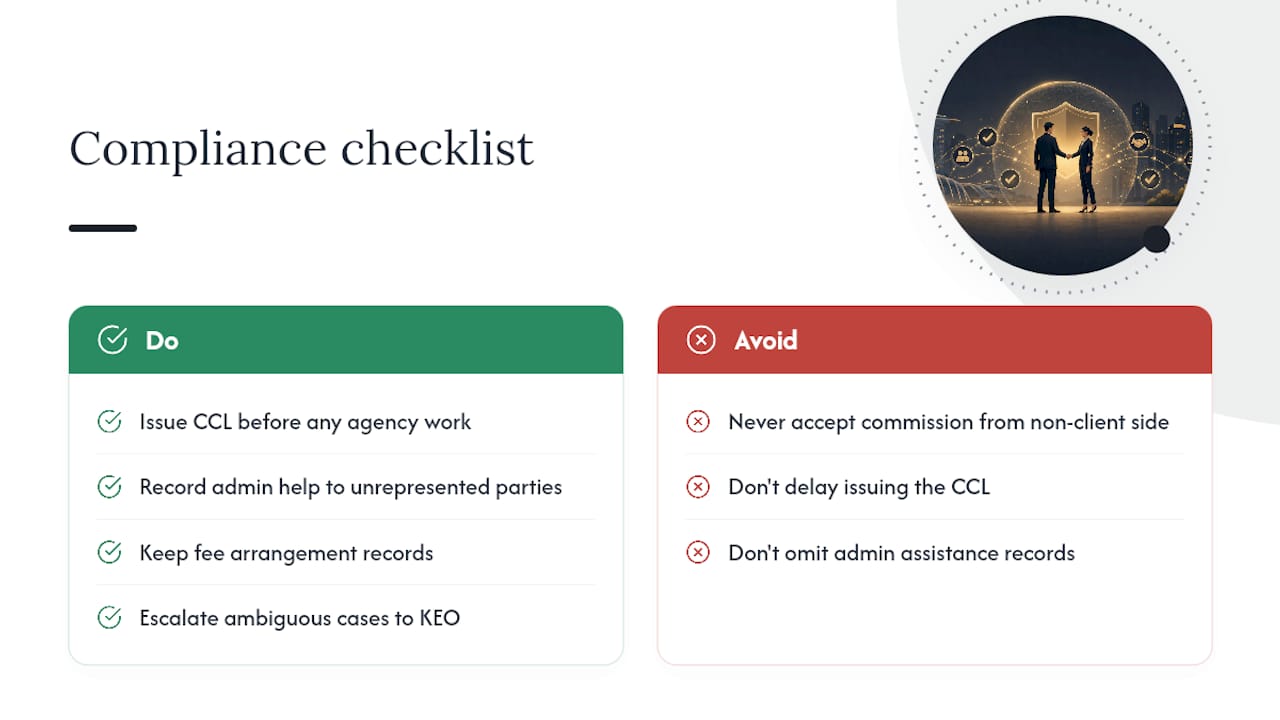
New and experienced agents should watch for these compliance steps:
Issue a CCL to every client before performing estate agency work for them.
Document any administrative help given to the unrepresented party in writing, including a clear statement that no representation or fee is involved.
Decline any request to collect commission from both parties, even informally.
Escalate ambiguous situations to your Key Executive Officer (KEO) before proceeding.
Pro Tip: If you find yourself holding both sets of keys, collecting both commission checks, or drafting both parties’ offer letters, stop and ask whether you’ve quietly become both agents in the deal without meaning to.
Red flags worth naming outright: an agent who collects fees from both vendor and purchaser, one who controls all the paperwork so neither side sees independent terms, or one who actively discourages either party from getting their own advice. CEA’s guidance on conflicts of interest treats each of these as warning signs regulators look for during investigations.
How CEA Enforces the Ban: A Real Case
Regulatory language can feel abstract until you see how it plays out for an actual agent. CEA’s published record of a disciplinary case gives a concrete picture. A former real estate salesperson was found to have collected commission from both the landlord and tenant in a rental transaction, a textbook instance of dual representation. The case also revealed the agent had failed to advise on HDB’s Minimum Occupation Period (MOP) requirements, a separate but related lapse that surfaced during the same investigation.
The salesperson was fined a sum of money following the investigation, and the case became one of CEA’s cited examples of how dual representation and other compliance failures tend to surface together rather than in isolation.
That pattern isn’t a coincidence. When enforcement cases get scrutinized, dual representation rarely shows up as a standalone issue. An agent willing to blur the line on representation is often the same agent skipping other duties, like flagging MOP restrictions before a tenant signs a lease on an HDB flat. Typical enforcement outcomes range from formal Letters of Advice for lower-severity lapses to fines, disciplinary records that follow an agent’s licensing history, and in more serious cases, criminal charges under the Regulations. If a transaction touches HDB rules, the Housing & Development Board may also step in separately from CEA’s own enforcement action.
What to Do If You Suspect Dual Representation
If something about your transaction feels off, verification takes minutes. Start with the CEA public register, where you can confirm an agent’s registration status and review any disciplinary history tied to their license. Pay attention to whether the agent listed matches the person you’ve actually been dealing with. That mismatch alone is worth a follow-up call to their agency.
Before filing anything, gather your evidence:
Screenshots of messages where the agent discusses representing or assisting both sides
Copies of any signed agreements, including the Client Care Letter (or its absence)
Receipts or bank records showing who paid commission to whom
Emails or texts requesting payment from both parties
CEA’s disciplinary case notes consistently point to commission-payment evidence as the detail investigators weigh most heavily, since it directly shows whether an agent was compensated by both sides of a deal.
When you file a complaint with CEA, include the agent’s registration number, a timeline of events, and every piece of supporting documentation you’ve collected. Investigations typically follow up with both the agent and their appointed agency before any disciplinary outcome is decided. If your situation also involves an HDB flat nearing its MOP, or a private property matter under URA’s purview, flag those agencies separately since their compliance checks run independently of CEA’s process. For anything involving significant financial loss or a contested tenancy, loop in a lawyer alongside your regulatory complaint.
Compliance Steps Every Agent Should Build Into Their Practice
Avoiding a dual representation breach isn’t about memorizing statute numbers. It’s about building habits that make the violation structurally difficult to stumble into. New agents preparing for their RES exam and CEA registration should treat CCL issuance as non-negotiable on day one of any client relationship, not a formality to handle later.
A short working checklist: issue the CCL before doing any estate agency work, write down every instance of administrative assistance to an unrepresented party, and never touch commission from a side you don’t represent. Our guide to commission compliance covers the recordkeeping habits that keep fee arrangements defensible if CEA ever asks questions. When a situation feels ambiguous, escalate to your KEO before acting. That single habit prevents most inadvertent breaches before they happen. Browse more practitioner guidance for ongoing compliance updates as regulations evolve.
Why This Rule Protects More Than Just Paperwork
The ban on dual representation exists because a single agent cannot serve two opposing interests at once and negotiate honestly for either. A seller wants the highest price; a buyer wants the lowest. An agent representing both has no way to advocate fully for one without shortchanging the other, no matter how well intentioned they are.
That’s the ethical core beneath the statute, and it’s why enforcement doesn’t soften just because both parties consented. Better onboarding changes the outcome here more than stricter penalties do. Agents who understand the rule before they’re tempted to bend it, and who’ve internalized when to escalate rather than improvise, are the ones who never end up in a CEA case study.
— Donny
Training That Keeps Agents on the Right Side of the Rules
Structured onboarding means you learn the CCL process, commission handling, and dual representation boundaries before you’re negotiating a live deal, not after a complaint lands on your desk.

Our programs cover RES exam preparation, CEA registration requirements, and the practical fieldwork that turns statute knowledge into daily habits, backed by mentorship from agents who’ve handled these situations firsthand. If you’re newly licensed or about to be, our New Agents program walks you through onboarding with compliance built into the curriculum from week one. Experienced agents leading their own teams can find leadership frameworks and support through our Experienced Team Leaders track, where reducing your team’s regulatory exposure is part of the coaching, not an afterthought. Reach out to start the conversation about which path fits where you are.
Sources
FAQ
Is Dual Representation Ever Legal in Singapore With Client Consent?
No. Regulation 5 prohibits dual representation outright, and written or verbal consent from both parties does not make the arrangement legal.
What’s the Difference Between Co-Broking and Dual Representation?
Co-broking involves two separate agents, each representing one party exclusively, while dual representation is one agent trying to represent both sides of the same deal, which the Regulations forbid.
Can an Agent Help the Other Party With Paperwork?
Yes, but only if it’s clear they aren’t representing that party and no fee is charged for the help, according to government guidance on engaging property agents.
What Happens if an Agent Is Caught in Dual Representation?
Penalties can include a fine not exceeding $25,000, imprisonment for a term not exceeding 12 months, or both, along with a disciplinary record tied to the agent’s CEA license.
How Do I Check if My Agent Is Properly Registered?
Search the agent’s name or registration number on the CEA public register, which shows current licensing status and any disciplinary history.
Recommended
Comments