
GST on Commissions: Singapore Agent's Compliance Guide

If you are a GST-registered agent or small business in Singapore, you must charge GST on commissions you earn from brokering services. The Inland Revenue Authority of Singapore (IRAS)/charging-gst-(output-tax)/when-to-charge-goods-and-services-tax-(gst)) is clear: output tax applies to the total price of every taxable supply you make, and commission income qualifies as a taxable supply. The prevailing GST rate in Singapore is the standard rate currently applied to taxable supplies.
Three rules to know immediately:
Who charges: Any GST-registered individual or business earning commission income must charge GST on that commission, regardless of whether they are a sole proprietor, partnership, or company.
Rate and threshold: The current rate is 9%. Registration becomes compulsory once your taxable turnover exceeds S$1 million in a 12-month period, though voluntary registration is available below that threshold.
Key exception flags: If you supply a zero-rated service (for example, certain international services) or an exempt supply, different rules apply. Commission on residential property sales is not exempt just because the property itself may be.
Pro Tip: Check your GST registration status before your next commission invoice goes out. Issuing an invoice without GST when you are registered, or charging GST when you are not, both create compliance exposure.
Key Takeaways
GST applies to commission income in Singapore whenever the agent or business is GST-registered and the commission is earned from a taxable brokering service, regardless of the underlying property type.
Point | Details |
Commission is always taxable | Brokering services attract 9% GST even when the underlying property sale is exempt. |
Registration threshold | Compulsory GST registration applies once taxable turnover exceeds S$1 million in any 12-month period. |
Invoice correctly | Every tax invoice must show your GST number, the pre-GST commission, the GST amount, and the total separately. |
Time of supply | The tax point is the earlier of the invoice date or the date payment is received, including deposits. |
Keep records five years | Retain signed agency agreements, tax invoices, and payment records for at least five years for IRAS audit readiness. |
Table of Contents
Does GST apply to commissions? What IRAS says
IRAS defines a taxable supply as any supply of goods or services made in Singapore that is not exempt. Commission income, which is payment for a brokering or agency service, falls squarely within that definition.
The registration trigger matters here. IRAS requires compulsory registration when your taxable turnover crosses S$1 million over any 12-month period, looking backward or forward. For many full-time property agents, a single productive year can push turnover past that mark. Part-time agents with lower volumes may stay below it, but the option to register voluntarily still exists and can be advantageous if your clients are themselves GST-registered businesses that can claim input tax credits.
IRAS guidance states: “GST-registered businesses must charge GST on taxable supplies made in Singapore. Output tax is computed on the total price of the taxable supply.” This means the full commission amount, including any mandatory service charges bundled into it, forms the taxable base.
The distinction between taxable, zero-rated, and exempt supplies is worth anchoring clearly:
Taxable supplies (standard-rated): Commission for brokering property or services in Singapore. GST at 9% applies.
Zero-rated supplies: Certain international services where the recipient is overseas. GST is charged at 0%, but the supply is still technically taxable, so input tax credits remain claimable.
Exempt supplies: Specific financial services and the sale or lease of residential property. No GST is charged, and input tax recovery is restricted.
The critical point is that commission income does not inherit the GST status of the underlying transaction. A commission earned on a residential property sale is not exempt just because the property sale itself is. That distinction trips up many agents.
How GST applies to real-estate commissions in Singapore
IRAS confirms that commissions received for brokering services are subject to GST regardless of whether the underlying property is residential or non-residential. The brokering service is the taxable supply, not the property transaction itself.
This has direct practical consequences for agents and their clients:
Residential sales: The property sale may be exempt from GST, but the agent’s commission is not. A GST-registered agent must charge 9% on their commission fee.
Commercial and industrial properties: Both the property transaction and the commission are typically taxable, so GST applies at both levels.
Co-broking arrangements: When two agents split a commission, each agent accounts for GST on their own share. The referring agent issues a tax invoice for their portion; the receiving agent does the same for theirs.
The invoice name test is one of the most overlooked compliance points. If an agent issues an invoice in their own name for services rendered, IRAS treats the agent as the supplier and the commission as the agent’s taxable revenue. If the agent invoices in the principal’s name (acting purely as a disclosed agent), the tax treatment may shift to the principal. Most property agents in Singapore invoice in their own name through their agency, which means the agency’s GST registration governs the transaction.
Seller-paid commissions are the norm in Singapore residential transactions, but buyer-paid arrangements exist in commercial deals. Either way, the party paying the commission cannot claim input tax credit unless the agent issues a valid tax invoice showing the GST amount separately. This is where CEA’s professional service manual becomes practically useful: it provides recommended contract language that specifies who pays the commission and how GST is disclosed, reducing disputes before they start.
Pro Tip: Update your standard agency agreement to include a clause stating whether the quoted commission is inclusive or exclusive of GST, and which party bears the GST cost. CEA’s agreements and checklists give you ready-made templates to build from.
Absorbing GST is a commercial decision, not a tax exemption. The agency’s output tax liability remains unchanged.
For agents working in commercial brokerage, understanding how broker fees are structured in Singapore’s office market can help you frame commission conversations with clients more clearly, particularly when GST adds a visible line to the invoice.
When to charge and report GST: time of supply rules
The time of supply determines which GST filing period your commission falls into. For services, IRAS uses the earlier of two triggers: the date you issue the tax invoice, or the date you receive payment. Whichever comes first sets the tax period.
IRAS time-of-supply rule for services: The tax point is the earlier of the invoice date or the date of payment received. For commission income, this typically means the invoice date governs unless the client pays a deposit or advance before the invoice is issued.
Practical implications for common commission events:
Advance retainer or deposit received before invoice: GST is due in the period the payment is received, even if the full commission invoice comes later.
Invoice issued before completion: The tax point is the invoice date. If your agency invoices on the date of option exercise rather than completion, GST falls in that earlier period.
Cancellation charges: IRAS guidance on service-sector charges confirms that cancellation fees are taxable when they compensate for a service rendered, not purely as a penalty. If your agency agreement specifies a cancellation fee for a deal that falls through after services were performed, that fee carries GST.
A valid tax invoice for commission transactions must include: the words “Tax Invoice,” your GST registration number, the invoice date, a description of the service, the commission amount before GST, the GST amount, and the total amount payable. A bill of supply (without GST) is issued only when the supply is zero-rated or exempt. Issuing a bill of supply for a standard-rated commission is an error.
Records must be kept for at least five years. This includes signed agency agreements, commission statements, tax invoices issued and received, and bank statements showing payment dates. The payment date record is particularly important because it can shift the tax point when payment precedes invoicing.
How to calculate GST on a commission: worked examples
The mechanics are straightforward once you know whether the quoted commission is GST-exclusive or GST-inclusive.
Example 1: Commission quoted exclusive of GST
An agent earns a commission on a commercial property transaction. The commission can be quoted exclusive of GST.
Commission (before GST): a specified amount
GST at the standard rate applicable
Total payable by client: commission plus GST
The tax invoice shows S$10,000 as the taxable amount and S$900 as GST separately.
Example 2: Commission quoted inclusive of GST
A client has agreed to pay a total of S$10,900 inclusive of GST. To back out the GST component:
GST fraction: 9 ÷ 109
GST amount: S$10,900 × (9/109) = S$900
Commission before GST: S$10,000
This calculation matters when your agency agreement states a lump-sum fee and you need to determine how much to remit to IRAS.
Example 3: Commission with a mandatory service charge
IRAS guidance for the hotel and F&B sector illustrates the principle that applies across sectors: GST is calculated on the combined total of the base price plus any mandatory service charge. The same logic applies to commissions that include a bundled service fee.
Line item | Amount |
Base commission | S$10,000 |
Mandatory service charge (10%) | S$1 million |
Subtotal | S$10,900 |
GST at the applicable standard rate on the total amount including any mandatory service charge | S$900 |
Total payable | S$10,900 |
Splitting the service charge onto a separate invoice to reduce the GST base does not work. IRAS treats the combined amount as the taxable value when the charge is mandatory and part of the agreed price.
Common mistakes agents and small businesses make
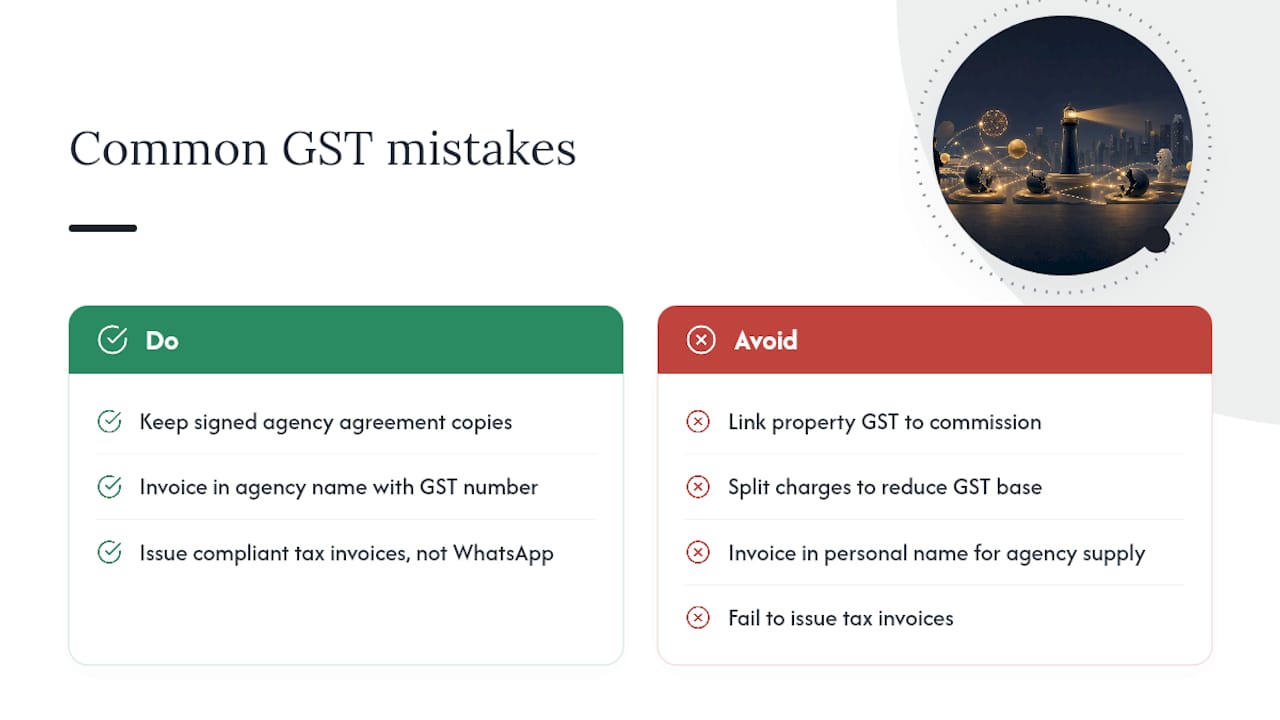
The most frequent error is linking the GST status of the property to the taxability of the commission. An agent who sells a private residential apartment may reason that because the property sale is exempt, their commission is also exempt. It is not. The brokering service is a separate taxable supply.
A common audit trigger: Agents who issue invoices without GST on residential commissions, believing the residential exemption covers their fee, often face IRAS assessments for under-declared output tax. The exemption applies to the property transaction, not the agency service.
Three other errors appear regularly:
Splitting charges to reduce the GST base. Some agents separate “consultation fees” from “commission” on invoices, hoping to keep individual line items below a threshold or to reclassify part of the income as non-taxable. IRAS looks at the substance of the supply, not the label on the invoice. If the combined charge is for one brokering service, the full amount is taxable.
Issuing invoices in the wrong name. An agent who invoices in their personal name when the supply is made through a GST-registered agency creates a mismatch. The agency’s GST number must appear on the invoice, not the individual agent’s personal details. Clients who receive a personal invoice cannot claim input tax credit against it.
Failure to issue tax invoices at all. Some agents send informal commission statements or WhatsApp messages confirming payment. These do not qualify as tax invoices. Clients who are GST-registered businesses cannot claim input tax credit without a compliant tax invoice, which creates friction and potential disputes.
Pro Tip: Keep a signed copy of every agency agreement alongside the corresponding tax invoice and payment record. If IRAS ever queries a commission transaction, the audit trail showing the agreed fee, the GST treatment, and the payment date resolves most questions without escalation.
Practical checklist for agents and small businesses
Follow these steps to align your commission processes with GST requirements today.
Immediate actions:
Confirm your GST registration status on the IRAS myTax Portal. If your taxable turnover is approaching S$1 million, begin the registration process before you cross the threshold.
Review all current agency agreements. Add a clause specifying whether the commission is quoted inclusive or exclusive of GST, and which party is responsible for the GST amount.
Update your invoice template to include all mandatory tax invoice elements: your GST registration number, invoice date, service description, pre-GST amount, GST amount, and total.
Set up a simple spreadsheet or accounting tool to track commission income by tax period, so your quarterly GST return reflects the correct output tax.
Ongoing compliance:
File GST returns on time (quarterly for most registered businesses) and reconcile commission income against invoices issued.
Retain all records, including agency agreements, tax invoices, and bank statements, for at least five years.
Review input tax credits you can claim on business expenses related to your commission income, such as marketing costs and professional fees.
When co-broking, confirm that the co-broke agent is also GST-registered if their commission share exceeds the registration threshold, and ensure each party invoices their own portion correctly.
For agents just starting out, understanding how GST interacts with your income from day one is part of building a sustainable practice. Myeracareer’s resources on agent income in Singapore cover how commission structures work in practice, including the regulatory context that shapes take-home pay. If you are still working through the licensing process, the step-by-step guide to becoming a property agent explains CEA onboarding requirements alongside the financial obligations new agents face.
When uncertainty arises, consult a qualified tax practitioner. GST rules for agency arrangements can become complex when multiple parties, co-broking splits, or overseas principals are involved, and a one-hour consultation is far less costly than an IRAS assessment.
What handling GST on commissions actually looks like in practice
When I first started advising agents on commission workflows, the single most common gap was not the calculation itself. It was the moment between closing a deal and issuing the invoice, where the excitement of a successful transaction overshadowed the compliance step. Agents would send a congratulatory message to the client and follow up with an informal payment request, sometimes days later, with no GST line in sight.

The fix is procedural, not technical. Build the tax invoice into your deal-closing checklist so it goes out the same day as the commission confirmation. State the GST amount as a separate line, reference your GST registration number, and keep a copy filed against the transaction record. Clients who are businesses will thank you for it because they need that invoice to claim their input tax credit.
One operational tip that experienced agents often overlook: use your sales pipeline tracking system to flag the invoice date and payment date for every deal. When those two dates fall in different quarters, your GST return for the earlier period must reflect the earlier trigger date. Missing that distinction is how output tax ends up in the wrong filing period.
Myeracareer’s platform gives agents the tools and mentorship to handle these operational details confidently, from onboarding through to building a high-performing portfolio. If you are ready to build your career on a foundation that includes compliance support, the resources are there.

Whether you are preparing for your RES exam or considering a move to a team with stronger operational support, Myeracareer offers structured onboarding, AI-powered sales tools, and mentorship frameworks designed for agents who want to build long-term. Start your journey with ERA as a new agent and get the guidance you need to handle every part of your practice, including GST compliance, with confidence. Experienced agents looking for a team with deeper resources can explore what ERA offers experienced agents.
Sources
These official pages are the authoritative starting point for any GST question related to commissions and agency services in Singapore.
Always verify GST rules directly with IRAS or a qualified tax practitioner before applying them to your specific transactions. Official IRAS pages are the authoritative source, and rules can change with each Budget announcement.
This article provides general information on GST as it applies to commissions in Singapore and is not a substitute for professional tax advice. Confirm current rules and thresholds with IRAS or a qualified tax practitioner before making compliance decisions.
Recommended
Comments