
Performance Review Templates for Real Estate Agents: 2026 Guide


The most effective performance review template kit for U.S. real estate agents combines three components: a coaching-first scorecard, a scripted conversation guide, and a 90-day individualized development plan. Together, these give brokerages and team leaders a structured, repeatable system that drives behavior change rather than simply documenting it.
Here is what the kit contains at a glance:
Scorecard KPIs: Activity metrics (contacts, database touches), conversion ratios (lead-to-appointment, appointment-to-signed), and outcome figures (closed transactions, sales volume, days on market)
Scripted coaching prompts: Manager questions tied directly to each KPI band, so 1:1s stay focused and productive
90-day development plan: Observable actions, success metrics, and check-in dates that turn a score into a forward-looking commitment
Inman recommends alternating intensive coaching weeks with implementation weeks so agents have time to practice new habits before the next review cycle. Career With ERA, Donny Lee’s team-leader program, applies this exact cadence with onboarding templates and the Sales+ app built in.
Pro Tip: Start with five KPIs, not fifteen. Adoption collapses when agents see a wall of metrics on their first scorecard.
Key Takeaways
A coaching-first performance review template, built around activity, conversion, and outcome KPIs with a weighted rubric and structured 1:1 agenda, produces measurable behavior change where compliance-only reviews produce only paperwork.
Point | Details |
Use a three-part kit | Combine a scorecard, conversation guide, and 90-day development plan for every formal review. |
Weight conversion metrics highest | Assign — of the score to conversion KPIs; they reflect skill, not market luck. |
Match cadence to Inman’s model | Run weekly coaching touches, monthly scorecard checks, and quarterly formal reviews with implementation weeks built in. |
Automate data before you scale | Configure CRM fields for lead timestamp, appointment outcome, and closing date before expanding beyond the pilot group. |
Career With ERA accelerates rollout | Myeracareer’s template packages, manager certification, and Sales+ tools map directly to this scorecard and cadence. |
Table of Contents
How do you score KPIs fairly and trigger the right coaching response?
Where should scorecard data come from, and how do you automate it?
What compliance and recordkeeping practices protect your brokerage?
How do you roll out these templates across your brokerage in 30–90 days?
Why coaching-first templates outperform compliance-only reviews
Career With ERA gives you the templates, training, and tools to start this week
Which performance review template should you use, and when?
Four template variants cover every review context a brokerage encounters.
Daily/weekly activity check: A lightweight form (five fields maximum) tracking contacts made, database touches, and appointments set. Agents self-fill; managers review in under ten minutes. Best for new agents in their first 90 days.
Monthly scorecard (conversion-focused): Pulls lead-to-appointment and appointment-to-signed ratios alongside pipeline volume. Managers enter CRM-sourced figures; agents complete a brief self-assessment section before the meeting.
Quarterly formal review: The full agent performance review form combining activity, conversion, and outcome KPIs with a weighted score, rating band, and updated development plan. Both agent and manager prepare independently, then align in a 45–60 minute session.
Onboarding/licensing progress template: Designed for pre-licensed or newly licensed agents. Tracks exam prep milestones, CEA or state licensing steps, and early activity habits rather than closed transactions.
A structured coaching session checks commitments first, consolidates wins, then focuses on a single problem with clear next steps. Matching the right template to the right cadence keeps that structure intact.
Pro Tip: Keep any template to one printed page or one screen. If a manager needs to scroll twice, adoption drops.
What KPIs must every agent scorecard include?
Performance tracking works best as an ongoing coaching strategy when data informs daily behavior, not just quarterly reports. The table below organizes commonly recommended KPIs by category, formula, data source, and review cadence.
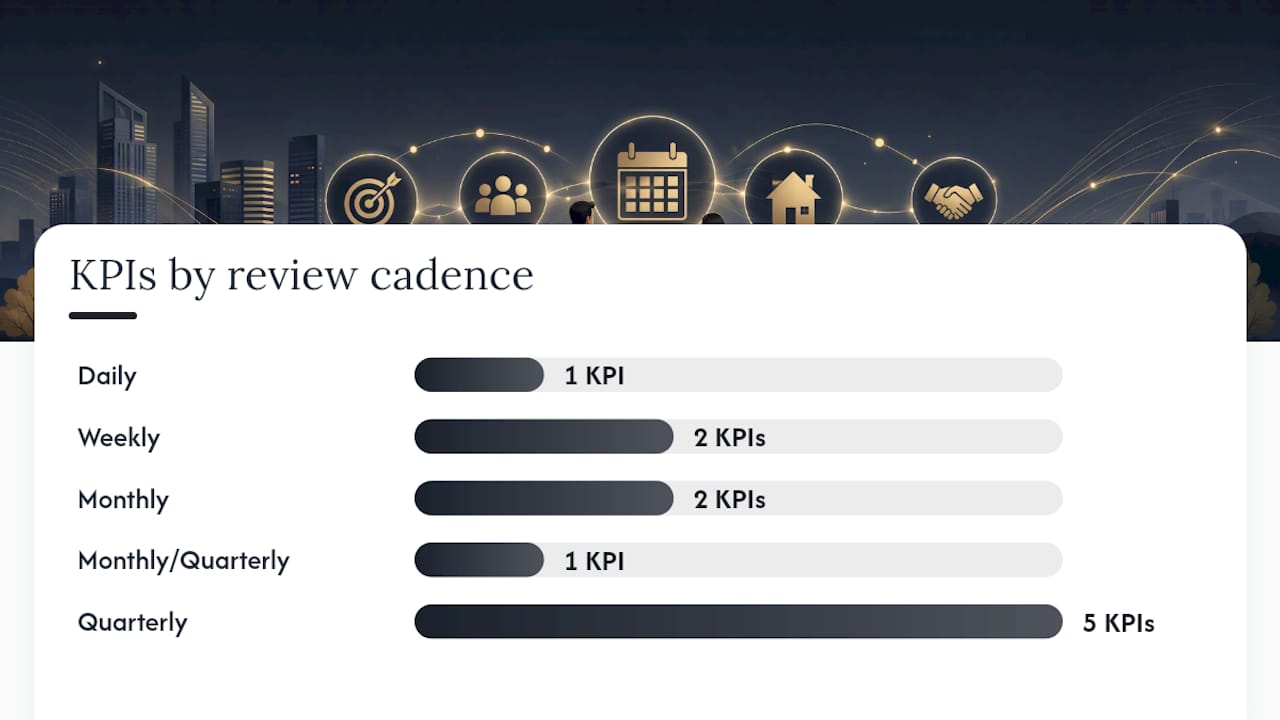
KPI | Formula / Definition | Data Source | Review Cadence |
Contacts per day | Total outbound contacts ÷ working days | CRM activity log | Daily |
Database touches | Unique records contacted in period | CRM sequences | Weekly |
Lead response time | Minutes from lead receipt to first contact | CRM timestamp | Weekly |
Lead-to-appointment % | Appointments set ÷ leads received × 100 | CRM pipeline | Monthly |
Appointment-to-signed % | Signed agreements ÷ appointments held × 100 | CRM pipeline | Monthly |
Closed transactions | Count of closed sides in period | Transaction management system | Monthly/Quarterly |
Sales volume | Sum of closed sale prices | Transaction files | Quarterly |
Average commission | Total gross commission ÷ closed transactions | Commission ledger | Quarterly |
List-to-sale price ratio | Sale price ÷ list price × 100 | MLS/IDX data | Quarterly |
Days on market | Average days from list date to contract date | MLS/IDX data | Quarterly |
Client satisfaction / referral rate | Referrals received ÷ closed clients × 100 | Post-close survey | Quarterly |
Real estate metrics become most meaningful when analyzed together across financial, operational, and marketing categories rather than in isolation. A strong sales volume figure paired with a weak lead-to-appointment ratio tells a very different story than either number alone.
Pro Tip: Balance leading indicators (contacts, response time) with lagging ones (closed transactions, volume). Leading indicators are what you coach; lagging indicators confirm whether the coaching worked.
How do you score KPIs fairly and trigger the right coaching response?
A weighted scoring rubric converts raw KPI values into a single headline score that tells a manager exactly what to do next. The recommended weight distribution for most teams balances activity, conversion, and outcome metrics, with conversion weighted most heavily because it reflects skill and consistency, not just market conditions.
Rating bands and what each triggers:
90–100: Exceeds expectations. Recognize publicly, discuss stretch goals, consider mentorship role.
75–89: Meets expectations. Reinforce strengths, assign one focus area for the next cycle.
60–74: Needs coaching. Trigger a formal coaching plan with weekly check-ins and defined milestones.
Below 60: Action plan required. Document in writing, set 30-day measurable targets, involve HR or principal broker.
Top teams use a concise set of high-signal KPIs weighted so the headline score drives behavior and simplifies manager 1:1s. The weighting scheme should shift based on agent profile:
Fairness controls matter as much as the formula itself. Adjust benchmarks for local market conditions (a slow quarter in a high-inventory market should not trigger an action plan for a consistently strong agent). Document tenure adjustments in writing, apply the same rubric to every agent in the same role, and tie all performance notes to observable behaviors and measurable KPIs rather than subjective impressions.
How should you run the review process from start to finish?
The recommended cadence is a weekly coaching touch, a monthly scorecard check, and a quarterly formal review. Inman advises alternating intensive coaching weeks with implementation weeks so agents can apply new habits before the next session.

Prework (agent): Complete the self-assessment section of the scorecard, pull personal transaction data, and write two wins and one challenge from the past period.
Prework (manager): Pull CRM and MLS data, compute the weighted score, and note one specific coaching focus based on the lowest-scoring KPI category.
45–60 minute meeting agenda:
Check commitments from the last session (5 minutes)
Review the completed scorecard together, confirm the score and rating band (10 minutes)
Name three specific strengths with evidence, then identify one core improvement area (15 minutes)
Agree on 7–14 day observable actions with a named owner for each (10 minutes)
Document the updated development plan and schedule the next check-in (10 minutes)
Daily logging, weekly ratio review, and a monthly strategy check-in form the habit structure that separates agents who consistently hit targets from those who react to results after the fact.
Pro Tip: After an intensive coaching week, schedule a deliberate implementation week with no new concepts introduced. Behavior change needs breathing room.
What does a filled scorecard and coaching script look like?
Sample filled scorecard — mid-level agent, Q1 quarterly review:
Rating band: Needs coaching. Trigger: formal coaching plan with weekly check-ins.
Manager conversation scripts for common situations:
Low lead response time: “Your data shows an average response time of 47 minutes. Walk me through what happens between receiving a lead and making that first call. Where does the delay usually start?”
Weak appointment-to-signed conversion: “You’re setting appointments consistently, which is great. What’s your read on why fewer of those are converting to signed agreements? Let’s look at the last three that didn’t close.”
Strong client NPS or referral rate: “Your referral rate this quarter is your highest yet. What specifically did you do differently with past clients that you think drove that? Let’s make sure it’s in your development plan as a repeatable habit.”
Licensing or compliance lag: “Your CE credits are two modules behind the quarterly target. What’s the realistic path to completing those in the next 30 days, and what would help remove the obstacle?”
A score in the 60–74 band converts directly into a 30–90 day development plan: list three observable actions, assign a completion date to each, and define the metric that confirms success.
Where should scorecard data come from, and how do you automate it?
Reliable scorecards depend on clean, consistently captured data. The critical CRM fields to configure are: lead timestamp, sequence touch count, appointment outcome (held/no-show/converted), contract signed date, closing date, and final sale price. Without these fields standardized, managers spend review prep time hunting data instead of preparing coaching questions.
A three-tier tool approach matches team size and budget:
Tier 1 (manual/spreadsheet): Google Sheets or Excel with a shared template. Suitable for teams of 1–5 agents. Requires weekly manual entry; risk of inconsistency is high.
Tier 2 (CRM + dashboards): A CRM like Follow Up Boss, LionDesk, or kvCORE with a connected reporting dashboard. Automates activity and pipeline fields; managers pull a pre-built report before each 1:1. Suitable for teams of 5–25.
Tier 3 (automated analytics with alerts): Real-time dashboards with automated coaching alerts that flag when an agent’s response time or conversion ratio drops below threshold. Brokerages using real-time dashboards reduce manual reporting time and improve 1:1 quality by surfacing the coaching focus before the meeting starts. Myeracareer’s agent performance dashboard framework and sales pipeline tracking guidance show how to configure these fields for a real estate context.
Data governance checklist:
Designate one system of record (no parallel spreadsheets)
Standardize naming conventions for lead sources, appointment types, and transaction stages
Require CRM entry within 24 hours of each client interaction
Run a quarterly data audit to catch missing fields before review season
What compliance and recordkeeping practices protect your brokerage?
Every agent performance review must be defensible, nondiscriminatory, and tied to observable behavior. The core principle: document what the agent did, not what you think of them as a person.
Compliance checklist for U.S. brokerages:
Retain all signed performance review forms for a minimum of three years (consult your state’s real estate commission for jurisdiction-specific requirements)
Store records in a secure, access-controlled system (not a shared email thread)
Apply the same rubric and scoring weights to every agent in the same role category
Separate licensing status notes (CE credits, renewal deadlines) from performance coaching notes in distinct files
Tie every performance note to a specific KPI, date, and observed behavior
Never reference protected characteristics (age, gender, national origin, disability) in any performance document
Pro Tip: When a performance action could lead to termination, document a reasonable accommodation discussion and consult HR or your principal broker before issuing the written plan. One undocumented step in that sequence is the most common source of wrongful termination exposure.
How do you roll out these templates across your brokerage in 30–90 days?
30-day pilot:
Week 1: Select five KPIs, choose your scorecard template variant, and configure CRM fields
Week 2: Populate historical data for the pilot group (3–5 agents), train two managers on the rubric and meeting agenda
Week 3: Run the first pilot 1:1s using the filled scorecard and conversation scripts
Week 4: Collect manager and agent feedback, adjust KPI weights or template layout, and document what worked
60–90 day scale:
Certify all managers on the rubric and coaching cadence before expanding
Roll out the dashboard or reporting layer to the full team
Adopt the quarterly review as formal brokerage policy with signed acknowledgment from each agent
Schedule the first full-cohort quarterly review cycle
Stakeholder acceptance criteria before moving from pilot to scale:
Managers can compute a weighted score without assistance
Agents understand what each rating band means and what it triggers
CRM data is complete for at least 90% of required fields
At least one development plan has been documented and followed up
Why coaching-first templates outperform compliance-only reviews
Most brokerages treat the annual performance review as a legal formality: fill the form, get a signature, file it away. That approach produces compliant paperwork and almost no behavior change. The evidence points in a different direction. When a scorecard is built around leading indicators like lead response time and appointment conversion, and when the review meeting follows a structured coaching format, agents leave with specific commitments rather than vague feedback. The Inman coaching cadence, alternating intensive and implementation weeks, works precisely because it gives agents a behavioral target and then space to practice it before the next accountability moment. Compliance-only reviews skip that loop entirely.
Career With ERA’s programs, which Donny has contributed to directly, are built on this coaching-first model. The templates, manager training, and Sales+ tools are designed to make the scorecard a living coaching instrument, not an annual checkbox.
Career With ERA gives you the templates, training, and tools to start this week
Faster agent development comes from having the right system in place before the first review meeting, not from building one from scratch under pressure. Career With ERA provides manager training, onboarding templates, and Sales+ tools that map directly to the scorecard and cadence described in this guide.

Three practical ways the program supports implementation:
Template packages: Pre-built scorecard forms, self-assessment sections, and development plan templates calibrated to U.S. brokerage standards
Manager certification: Structured training on the rubric, coaching cadence, and conversation scripts so every manager runs consistent 1:1s
Dashboard setup: Guidance on configuring CRM fields and reporting views so scorecard data populates automatically
New agents get onboarding templates and licensing progress trackers from day one. Experienced team leaders get the full manager certification and quarterly review framework. Connect with Donny’s team at Career With ERA to schedule a walkthrough and get your first scorecard configured this week.
Sources
What To Know Before Implementing A Real Estate Brokerage Coaching Plan | Inman Real Estate News
Real Estate Agent Performance Tracking: 2026 Guide - Pittsburgh Realtors
Real estate metrics: 33 essential KPIs across finance, operations, and marketing | NetSuite
The Real Estate KPI Guide: What Every Agent Should Know - blogs
Recommended
Comments